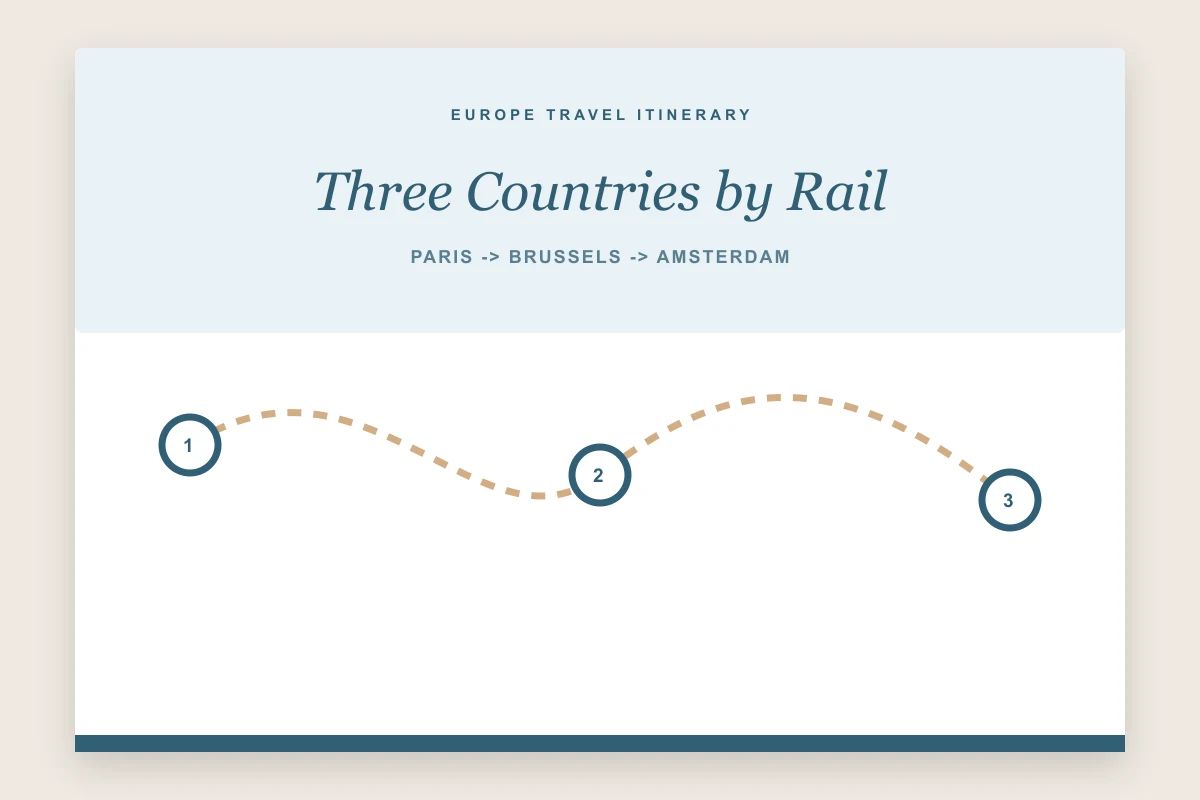
What should a Europe travel itinerary template include?
A useful Europe travel itinerary template has to do more than list attractions. Multi-country journeys create handoffs: one hotel ends before the next begins, a train leaves from a particular station, a flight may use a distant airport, a border can have different document rules, and the next city may use another currency or time zone. This planner keeps dates, overnight bases, transport, accommodation, bookings, practical checks, daily activities, notes, and estimated costs in one chronological view.
Searchers also describe this as a Europe trip planner template, European itinerary template, multi-country travel planner, Europe itinerary spreadsheet, or two-week Europe itinerary template. Those phrases point to the same job: turn a route idea into a plan that can be edited, shared, printed, and used offline. The editor supports extra days and destinations, stores changes locally in the current browser, and exports PDF, Excel, Google Sheets-ready XLSX, and Word files without an account.
How do you plan a multi-country Europe itinerary without rushing?
Count nights and full days before counting countries. An arrival day, hotel-change day, and departure day rarely provide the same time as a full local day. Place cities in a sensible geographic sequence, then calculate every transfer from hotel checkout to the next hotel check-in rather than comparing only the advertised train or flight duration. A shorter route with three usable days in each main city will often feel richer than a longer list dominated by stations and packing.
The ready-made 10-day Western Europe and 14-day Central Europe plans are editable starting points, not universal recommendations. Load the route closest to your trip, change the dates and accommodation bases, and remove any stop that makes the pace uncomfortable. Add fixed museum entries, tours, or restaurants only after the route works. Keep at least one flexible block in each city and avoid depending on an unprotected tight connection for an important onward journey.
How should you track borders, trains, currencies, and bookings?
Europe, the EU, the Schengen Area, and the euro area describe different groups, so never assume one rule or currency applies to the whole route. Check the nationality and circumstances of every traveler against official government or EU guidance, including transit points and destinations outside Schengen. Travelers whose stays are subject to the Schengen short-stay limit should use the European Commission's official calculator and keep previous entry and exit dates accurate.
For each rail leg, record whether the booking is one through-ticket or separate contracts, the correct station names, local departure time, seat requirements, luggage considerations, and a realistic connection buffer. Confirm current details with the operator or pass provider. Use one home or comparison currency for a clean budget total, but keep the original amount and currency in the notes when exchange-rate accuracy matters. Save tickets offline, while keeping passwords, full passport details, payment information, and accommodation access codes in a secure location rather than the shared itinerary.