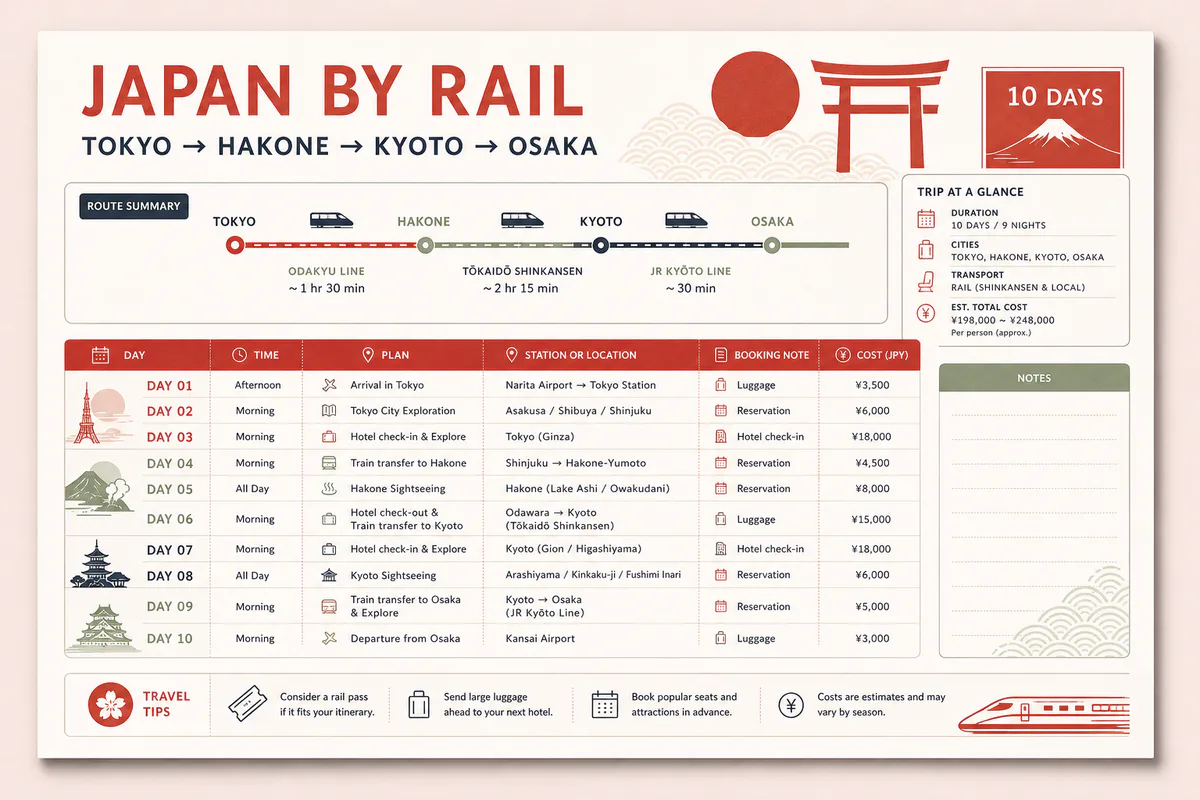
Why use a Japan travel itinerary template?
A Japan travel itinerary template is most useful when it solves the route between cities, not just the list of sights inside them. First-time itineraries often combine Tokyo, Kyoto, and Osaka, then add Hakone, Nara, Hiroshima, Kanazawa, or another regional stop. Every extra base introduces a station choice, hotel change, luggage decision, travel cost, and check-in window. The template makes those transitions visible before the daily schedule becomes crowded.
Search demand clusters around a 7 day Japan itinerary template, 10 day Japan itinerary, 14 day Japan itinerary, printable planner, and Google Sheets version. This editor does not force one trip length or a fixed route. Start with the sample 10-day rail journey, remove cities that do not suit the trip, add longer stays where you want a slower pace, and download PDF, Excel, Google Sheets-ready XLSX, or Word. The result is a reusable plan rather than a generic list of recommendations.
What should a Japan itinerary template include?
A practical Japan itinerary template should include arrival and departure airports, overnight cities, hotel names and addresses, the station used for every intercity transfer, departure times, seat or booking details, daily neighborhoods, timed reservations, estimated yen costs, and luggage notes. Add the exact station exit when it matters, because large stations can add meaningful walking time. Keep passport numbers, payment data, ticket QR codes, and accommodation access codes outside a broadly shared copy.
Place fixed reservations first and group the rest of each day geographically. A morning in Asakusa and an afternoon in Ueno usually produces a calmer plan than crossing Tokyo repeatedly for isolated attractions. On transfer days, allow time to check out, reach the right station, find the platform, travel, reach the next hotel, and store or collect bags. The Japan travel itinerary template supports several activities on one date while keeping the relevant city and transportation context visible.
How do you plan trains, reservations, and luggage in Japan?
Use current route tools to compare individual fares and passes instead of assuming one rail product is always cheaper. Record the railway company, station pair, preferred departure, seat status, and transfer time in the Japan travel itinerary template. Some long-distance or limited services merit advance planning, while frequent city trains can remain flexible. Availability and conditions change, so official operator information should decide what you actually book.
Luggage can shape the route as much as the train schedule. If you use a delivery service between hotels, record the send date, expected arrival date, destination hotel, and what remains in your overnight bag. Check the carrier and transport provider’s current size, timing, and acceptance rules. For certain shinkansen routes, oversized baggage may require an appropriate seat reservation. Keeping that decision beside the transfer prevents a useful planning detail from disappearing into email.